Getting Around China: Trains, Traffic, and Two Feet
From high-speed trains and sleeper cars to packed subways and walkable mega-cities, this guide breaks down how to navigate China’s transportation system as a foreigner—chaos, culture shock, and all.
TRAVELING IN CHINAACCOMMODATIONS AND TRANSPORTATION
1/8/20265 min read

Getting Around China: Trains, Traffic, and Two Feet
Your Survival Guide to China’s Transit
China is big. Really big. The kind of big where you casually hop on a train, read a few chapters of your book, and suddenly you’re in an entirely new city with different snacks, accents, and skyline vibes. If you’re a foreigner traveling through places like Shanghai, Beijing, Changzhou, Suzhou, and around Liyang, the train system will quickly become your best friend—along with WeChat, your legs, and the occasional overnight sleeper train that feels like a slumber party with strangers.
Let me walk you through it. (get it, hehe)
Trains: China’s Real Main Character
If Europe has cute little rail passes, China has high‑speed trains that feel like flying without the airport drama. Between Shanghai, Suzhou, Changzhou, and other nearby cities like Liyang, trains run constantly. Miss one? Congrats, another one leaves in like… 12 minutes.
As a foreigner, the first time feels intimidating—but once you do it once, you’ll wonder why every country doesn’t operate this way.
What it’s actually like:
Stations are massive (emotionally prepare)
Security checks feel airport‑ish but faster
Your seat number is on your ticket and people actually respect it
The ride is smooth, quiet, and weirdly calming
Shanghai → Suzhou? ~30 minutes. Shanghai → Changzhou? Blink and you’re there. Beijing → Shanghai? Long ride, but high-speed makes it feel civilized.
You’re not “traveling”—you’re commuting between adventures.
One thing to keep in mind when traveling using the train system is that you cannot buy a ticket without a Chinese ID, so always prepare extra time in your day to go to the ticket counter and get your train ticket.
Sleeper Trains: Budget Hotel, But Make It Mobile
Now let’s talk about sleeper trains, because they deserve their own personality.
Imagine boarding a train at night, climbing into a bunk bed stacked three high, and waking up in a new city. That’s it. That’s the magic.
The vibes:
Curtains for privacy (thank you)
Strangers politely pretending not to exist
People brushing teeth in the aisle like it’s normal (it is)
Someone always eating instant noodles at 10pm
For longer routes—especially between major cities—sleeper trains are a foreign traveler’s secret weapon. You save money on a hotel, skip losing a full day to travel, and get a story out of it.
Pro tip: bring earplugs, wet wipes, and an open mind.
WeChat: The App That Runs the Country
WeChat is not optional. It’s not “nice to have.” It is how China functions.
With WeChat, you can:
Pay for literally everything
Buy train tickets
Scan menus
Message hotels
Navigate cities
Exist
As a foreigner, once your payment is set up, life becomes dramatically easier. No awkward cash moments. No “do you take Visa?” (They don’t.) Just scan, pay, go.
By day three, you’ll be scanning QR codes like a local and wondering why your home country is still swiping cards like it’s 2009.
Setting up WeChat can be problematic if you don’t get through all the steps, make sure to download it prior to your trip, get your bank account verified, and also your personal information verified. If you show up to China not ready to use WeChat, you’ll be basically stranded.
Another app that is extremely useful in China and works very similarly to WeChat that I would recommend downloading and having ready to use is an app called Alipay.
Subways: Organized Chaos, Underground Edition
China’s subway systems are massive, efficient, and shockingly easy to use once you stop overthinking them. In cities like Shanghai and Beijing, the metro feels less like public transportation and more like the bloodstream of the city—constantly moving, always full, and somehow perfectly timed.
Stations are spotless, signs are clear (yes, usually in English), and trains arrive so frequently that missing one barely registers as a problem. Rush hour is intense—expect to stand shoulder to shoulder with hundreds of your new closest friends—but everyone moves with purpose. No pushing, no panic, just collective momentum.
With WeChat or Alipay, getting through turnstiles is as simple as scanning a code and going. No fumbling for tickets, no confusion, just follow the flow and trust the system. Once you get the hang of it, the subway becomes the easiest way to cover long distances without feeling like you’re actually traveling.
It’s fast, reliable, and somehow calming—even when it’s packed. And as a foreigner, mastering the subway feels like a small victory that makes the entire city suddenly feel manageable.
Walking Everywhere (Yes, Even in Mega Cities)
Here’s something people don’t tell you: Chinese cities are incredibly walkable.
In places like Shanghai, Beijing, and Suzhou, walking isn’t just transportation—it’s how you discover the good stuff.
You’ll find:
Tiny bakeries with no English signs
Street food that smells too good to ignore
Hidden canals in Suzhou
Random parks filled with people dancing, practicing tai chi, or flying kites
Walking is where the city stops feeling overwhelming and starts feeling human.
Navigating as a Foreigner (Better Than You Think)
Is there a language barrier? Yes.
Is it impossible? Not even close.
People are helpful, patient, and used to trains full of travelers. Translation apps, station signage, and WeChat solve most problems. And honestly? Half the time you don’t need words—just follow the flow.
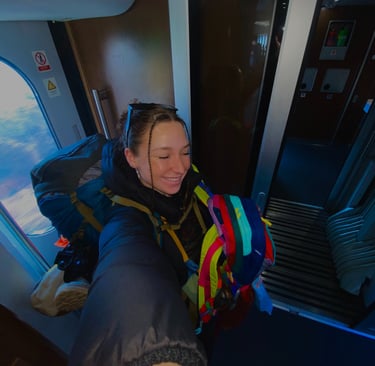
China’s transit system is designed for millions of daily riders. One confused foreigner with a backpack doesn’t even register.
China's roads aren't a free-for-all, but they do feel like Mario Kart on lap three-fast, loud, and slightly terrifying. Cars zip by (sometimes on the wrong side of the road), traffic lights come with countdown timers, and no one hesitates when it hit zero. Pedestrians beware.
The entire country drives in a chaotic, collective flow state. Children cling for dear life to the backs of their parents' bikes, and it is not uncommon to see three kids balanced on a single bike with an adult steering. These roads are not for the weak-but somehow, it all works. And despite the chaos, the experience of navigating it is absolutely worth it.
One thing to prepare for as a foreigner is that personal space works very differently in China. People will stand close to you, brush past you, and absolutely occupy any gap you leave open. If you pause in a line or leave space like you might at home, someone will step into it—not out of impatience or disrespect, but because that’s simply how movement works here.
It’s not aggressive, and it’s not unsafe. There’s no sense of threat, no pickpocketing anxiety, and no ill intent—just efficiency. In cities moving millions of people a day, space is shared, not reserved. People may be in your business, physically close, and very much present, but it’s all neutral and surprisingly calm once you adjust.
The best approach is to lean into it. Follow the flow, hold your ground gently, and don’t take it personally. What feels intense at first quickly becomes normal—and eventually, it just feels like another part of daily life in China.
Final Thoughts: Why the Train Is the Best Way to See China
Traveling China by train lets you:
See multiple cities without stress
Experience daily local life
Save money and time
Feel independent as a foreigner
From sleek high‑speed rides between Shanghai and Jiangsu cities, to overnight sleeper trains that feel like a rite of passage, to navigating it all through WeChat and your own two feet—this is China travel at its best.
You don’t just visit cities.
You slide between them.
And honestly? Once you do it, you’ll never want to travel any other way.